
monkeygrass
(Liriope muscari)
This species is Introduced in the United States
ORIGIN: East Asia
GROWTH TRAITS: Liriope muscari is grass-like perennials with spreading root systems that produce small, scattered, fleshy, and peanut-shaped corms. Leaves are long, narrow, arching, and flat with smooth margins. Numerous cultivars of both species are available, with foliage ranging from deep glossy green to variegated white and green. The foliage of both species is evergreen in warm climates, but dies back in areas with cold winters. Bluish-purple to whitish flowers appear on narrow spikes in summer, giving way to small green berry-like fruits that turn black with maturity in the fall and winter. Big blue lilyturf has stolons and short rhizomes. It grows up to 18" (45 cm) tall with leaves up to 1" (2.5 cm) wide. Inflorescences typically extend beyond leaves.
REPRODUCTION: Spreads by seed, rhizomes, and corms. The seeds may remain viable for over 10 years under some conditions.
HABITAT: L. muscari tolerates a wide range of light and soil conditions, as well as heat, humidity, and drought. Both grow best in moist, fertile soil in partial shade.
LOOK-ALIKES: The combination of clumped growth, long flat grass-like leaves, and purple clustered flowers help differentiate these species from many unrelated potential look-alikes. Related species (including other lilyturfs, mondo grasses, and grape hyacinths) differ in either leaf length, flower shape/color, or root structures and measurements. L. muscari differs from L. spicata in being slightly taller, having wider leaves, and a more conspicuous inflorescence.
CITATIONS:
Rawlins, K.A., R.L. Winston, C.T. Bargeron, D.J. Moorhead, and R. Carroll. 2018. New Invaders of the Southeast. USDA Forest Service, Forest Health Assessment and Applied Sciences Team, Morgantown, West Virginia. FHTET-2017-05. Retrieved from http://bugwoodcloud.org/resource/pdf/FHTET-2017-05_New%20Invaders_SE.pdf
Selected Images
Maps
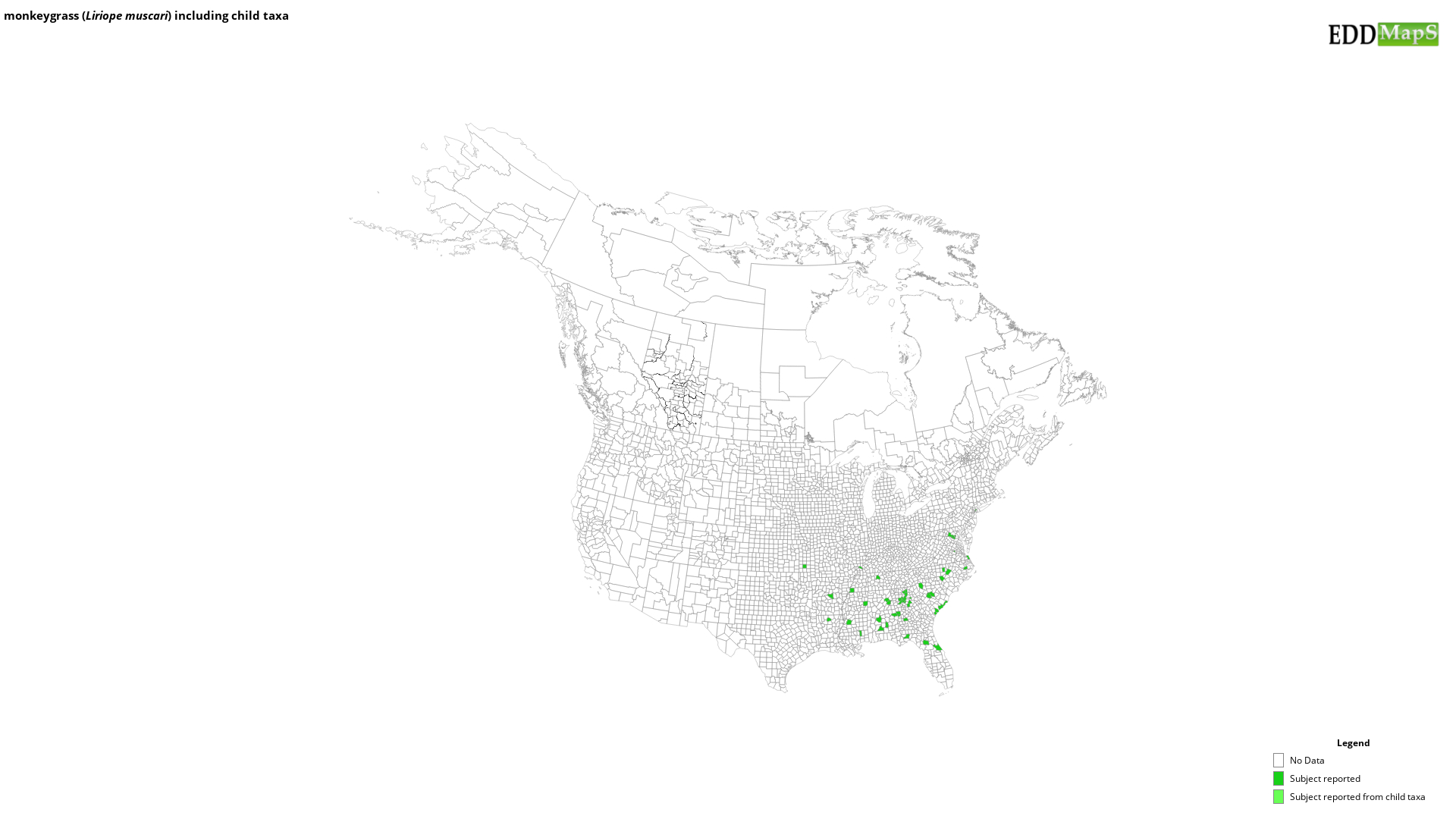
EDDMapS Distribution - This map is incomplete and is based only on current site and county level reports made by experts, herbaria, and literature. For more information, visit www.eddmaps.org
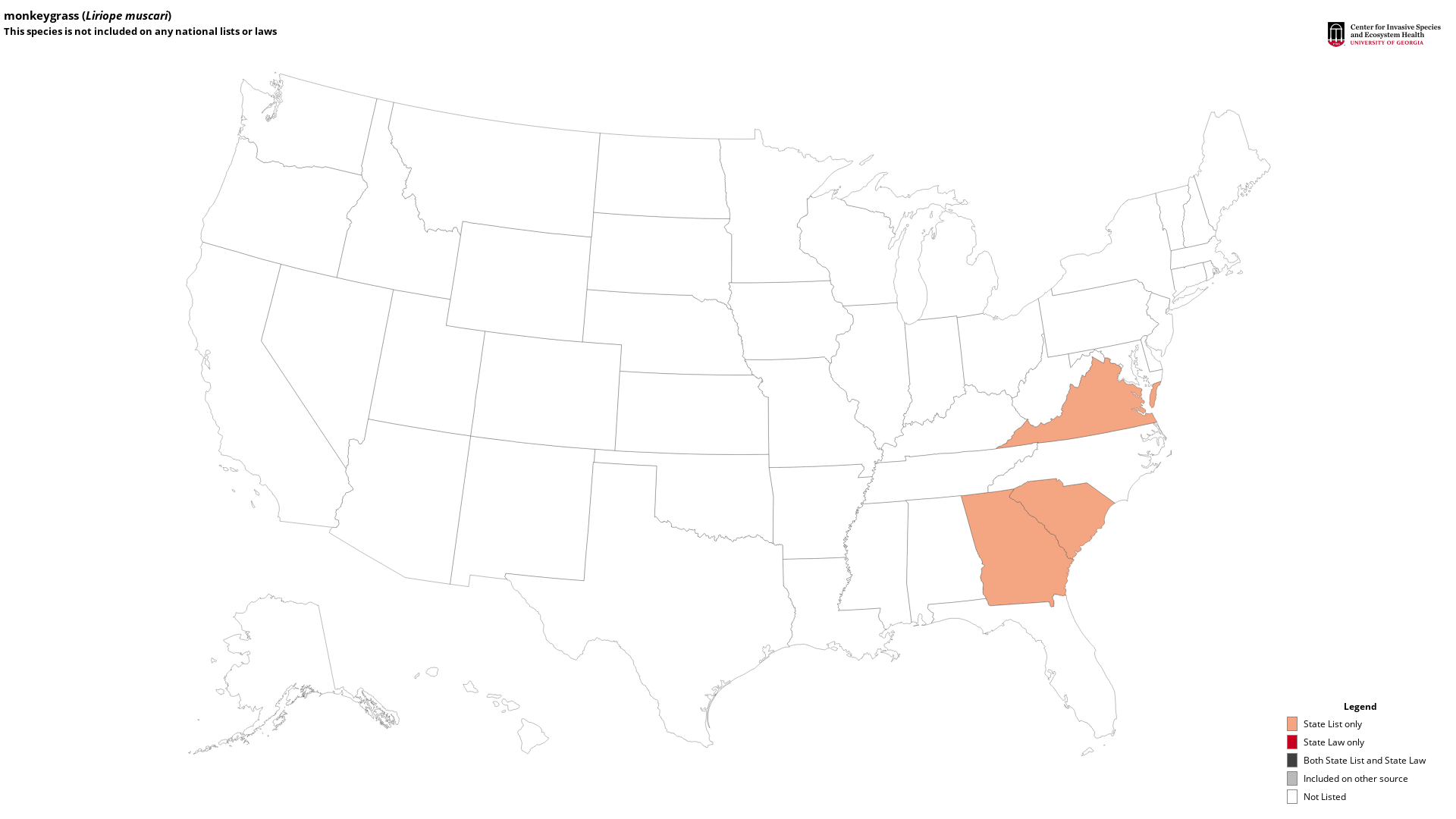
State Lists - This map identifies those states that have this species on their invasive species list or law.
Invasive Listing Sources
- Georgia Exotic Pest Plant Council - Category 3
- National Park Service, Mid-Atlantic Exotic Plant Management Team Invasive Plant List
- New Invaders of the Southeast
- Non-Native Invasive Plants of Arlington County, Virginia
- Non-Native Invasive Plants of the City of Alexandria, Virginia
- Nonnative Invasive Species in Southern Forest and Grassland Ecosystems
- South Carolina Invasive Pest Council
Taxonomic Rank
| Domain: Eukarya |
| Kingdom: Plantae |
| Phylum: Magnoliophyta |
| Class: Magnoliopsida |
| Superorder: Lilianae |
| Order: Asparagales |
| Family: Asparagaceae |
| Subfamily: Nolinoideae |
| Genus: Liriope |
| Liriope muscari |
References
Common Name Reference: USDA, NRCS. 2010. The PLANTS Database. National Plant Data Center, Baton Rouge, LA, USA.
Scientific Name Reference: USDA, NRCS. 2010. The PLANTS Database. National Plant Data Center, Baton Rouge, LA, USA.