
herb-robert
(Geranium robertianum)
This species is Introduced in the United States
Origin
Native to Europe and parts of Asia, North America, and North Africa. The United States specifically, is native to Washington, Oregon, California, Montana, and all states north of Tennessee and east of Minnesota except Iowa, Kentucky, and North Carolina.
Appearance
Geranium robertianum is an annual herb that grows from 11.8 to 15.7″ (30-40 cm) tall.
Foliage
Leaves are 2.4″ (6 cm) long, palmate, deeply cut, and often tinged with pink or red coloring. Leaves also release a very pungent odor. The stems are dark red in color and very brittle at joints.
Flowers
Flowers are bright pink, perfect, clustered in groups of 2 to 4, 0.6″ (15 mm) across with 5 rounded petals that have streaks of white. The blooming period occurs in summer.
Fruit
The fruit is long, thin, oval-shaped, 0.67″ (17 mm) long capsules that each contain five small oval dark brown seeds. Fruit ejects the seeds to distances of up to 20′ (6.1 m) when disturbed.
Ecological Threat
G. robertianum grows in shady, damp places in areas like along river banks and roadsides. In the United States, it can be found in Washington, Oregon, California, Montana, and all states north of Tennessee and east of Minnesota except Iowa, Kentucky, and North Carolina.
Selected Images
Maps
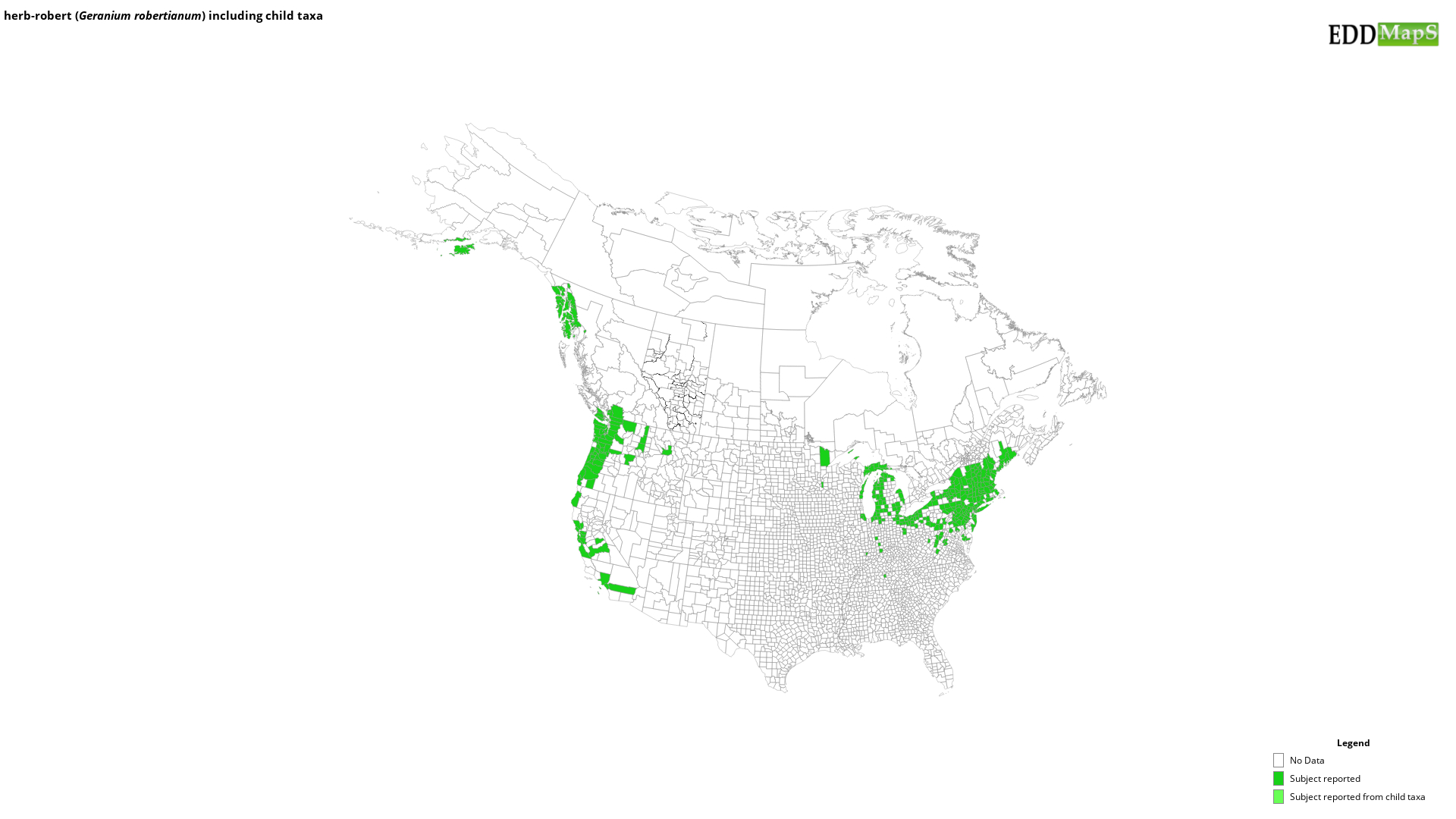
EDDMapS Distribution - This map is incomplete and is based only on current site and county level reports made by experts, herbaria, and literature. For more information, visit www.eddmaps.org

State Lists - This map identifies those states that have this species on their invasive species list or law.
Invasive Listing Sources
Taxonomic Rank
| Domain: Eukarya |
| Kingdom: Plantae |
| Phylum: Magnoliophyta |
| Class: Magnoliopsida |
| Superorder: Rosanae |
| Order: Geraniales |
| Family: Geraniaceae |
| Genus: Geranium |
| Geranium robertianum |
Other System Links
Plants: GERO
Bayer: GERRO
GRIN: 444
ITIS: 29119
NPDN Pest: PBZACBI
NPDN Host: 36385
References
Common Name Reference: Weed Science Society of America Common Names List
Scientific Name Reference: USDA, NRCS. 2010. The PLANTS Database. National Plant Data Center, Baton Rouge, LA, USA.