
roundleaf toothcup
(Rotala rotundifolia)
This species is Introduced in the United States
ORIGIN: India, Southeast Asia
GROWTH TRAITS: Fast-growing herbaceous perennial that can grow fully submersed, as an emerged aquatic, and as a terrestrial on shores of drained water bodies. All forms are rooted to the substrate with numerous branched stems growing 1-2.3' (0.3-0.7 m) long and forming creeping clumps by regularly rooting at stem nodes. Stems are soft and green, turning reddish with high light exposure, and have opposite leaves. Submersed leaves are green to reddish, narrow, lance-shaped, and up to 0.9" (2.2 cm) long. Emergent leaves are green, round, 0.4-0.8" (1-2 cm) long, and attach to the stem without petioles. Flowers are produced in clumped spikes at the ends of emergent stems in spring and early summer. Each flower has 4 small, bright pink petals. Fruits are small capsules that split at maturity to release 15-20 seeds each. Plants grow year-round.
REPRODUCTION: Spreads by seed and fragmentation. Seed longevity is unknown, but seeds of other Lythraceae are viable for three to many years. Stem fragments root from nodes.
HABITAT: Does best in warm, humid climates in wet soils and full sun, but can survive in colder climates and tolerates limited shade.
LOOK-ALIKES: Though many other aquatic species may have emergent pink flowers and/ or opposite leaves, roundleaf toothcup can be differentiated by having dissimilar emergent and submersed leaves and 4-petal flowers. The native lowland rotala (R. ramosior) and exotic Indian toothcup (R. indica) differ by having flowers that occur in leaf axils rather than at stem tips. The exotic purple loosestrife (Lythrum salicaria) grows much taller, has large lance-shaped leaves, and 5-7 petals on each flower.
CITATIONS:
Rawlins, K.A., R.L. Winston, C.T. Bargeron, D.J. Moorhead, and R. Carroll. 2018. New Invaders of the Southeast. USDA Forest Service, Forest Health Assessment and Applied Sciences Team, Morgantown, West Virginia. FHTET-2017-05. Retrieved from http://bugwoodcloud.org/resource/pdf/FHTET-2017-05_New%20Invaders_SE.pdf
Selected Images
Maps
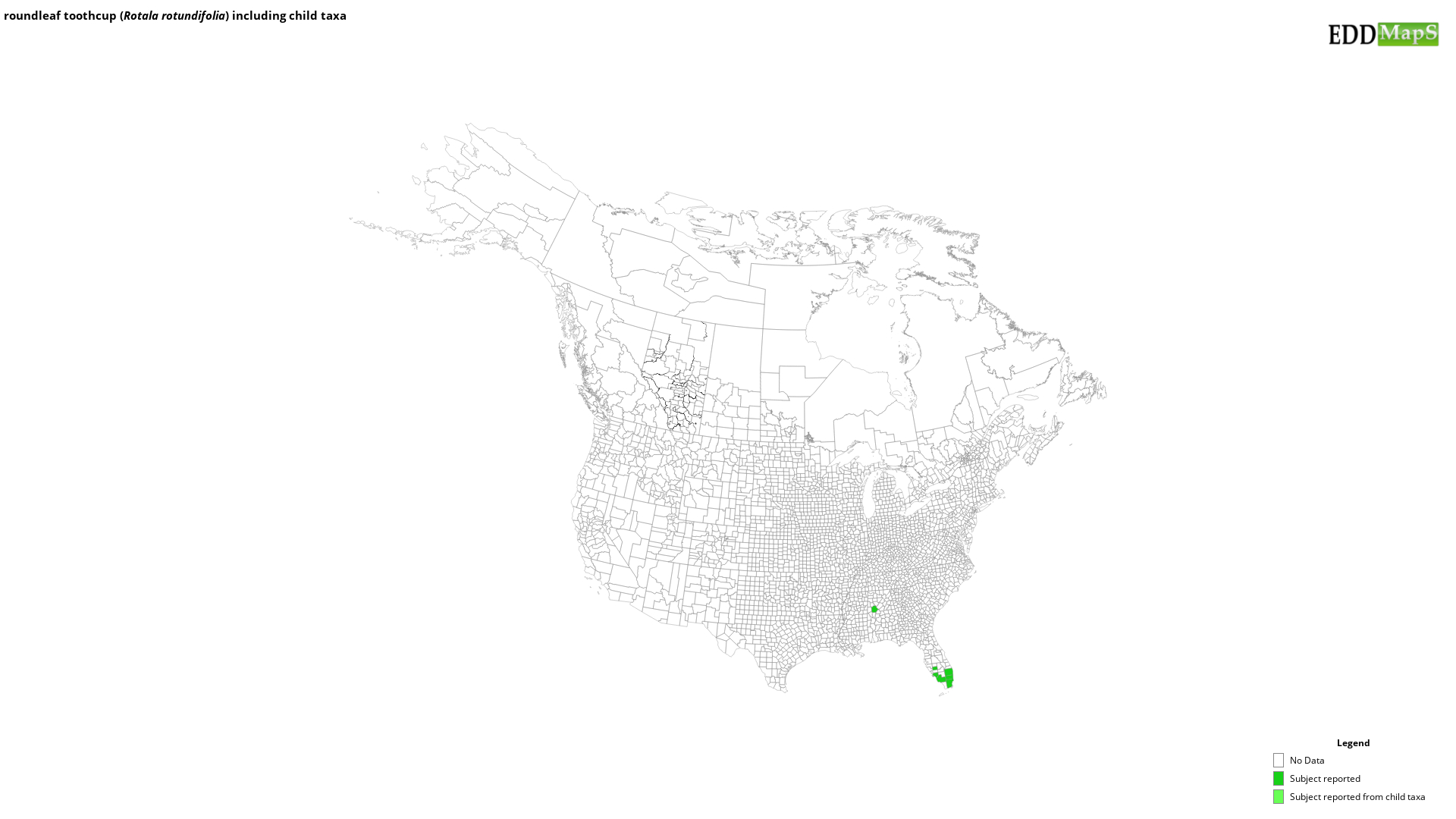
EDDMapS Distribution - This map is incomplete and is based only on current site and county level reports made by experts, herbaria, and literature. For more information, visit www.eddmaps.org
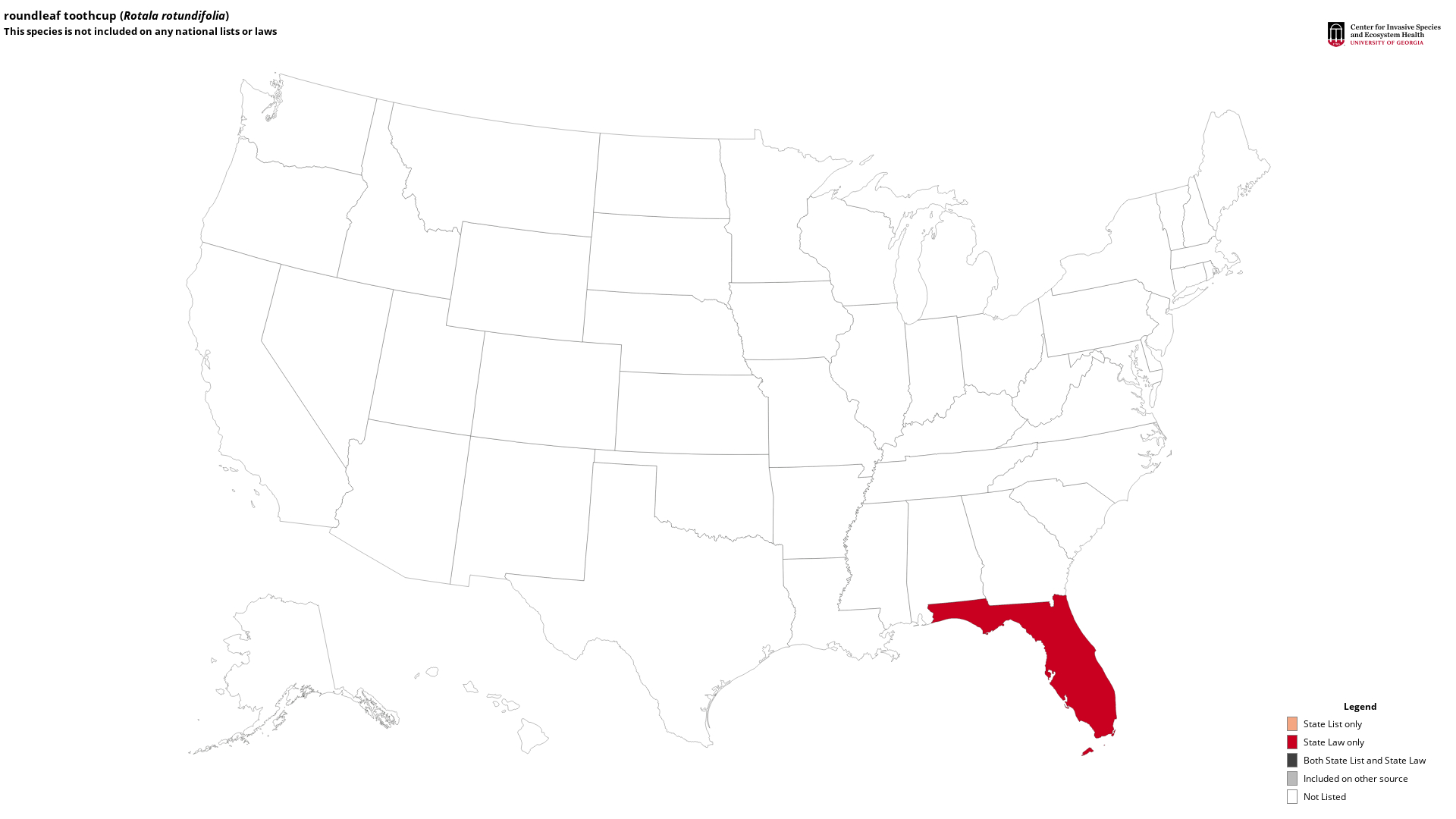
State Lists - This map identifies those states that have this species on their invasive species list or law.
Invasive Listing Sources
Taxonomic Rank
| Domain: Eukarya |
| Kingdom: Plantae |
| Phylum: Magnoliophyta |
| Class: Magnoliopsida |
| Superorder: Rosanae |
| Order: Myrtales |
| Family: Lythraceae |
| Genus: Rotala |
| Rotala rotundifolia |
References
Common Name Reference: USDA, ARS, National Genetic Resources Program. Germplasm Resources Information Network - (GRIN) [Online Database]. National Germplasm Resources Laboratory, Beltsville, Maryland. URL: http://www.ars-grin.gov/cgi-bin/npgs/html/queries.pl
Scientific Name Reference: USDA, ARS, National Genetic Resources Program. Germplasm Resources Information Network - (GRIN) [Online Database]. National Germplasm Resources Laboratory, Beltsville, Maryland. URL: http://www.ars-grin.gov/cgi-bin/npgs/html/queries.pl