
onerow yellowcress
(Nasturtium microphyllum)
This species is Introduced in the United States
ORIGIN: Asia, Europe, the Mediterranean
GROWTH TRAITS: Herbaceous, perennial aquatic, or semi-aquatic that is rooted in the substrate with a taproot and fibrous root system. Stems typically creep on soil or float on open water, growing up to 3.3' (1 m) long and forming sprawling clumps by regularly rooting at stem nodes. Stems are smooth, ridged, green, and hollow. Leaves are green (sometimes bronze),1-4" (2.5-10 cm) long, and divided into 3-7 leaflets. Leaflets are obovate with smooth or slightly wavy margins. The terminal leaflet is larger than the side leaflets. Stem leaves are alternate and decrease in size further up the stem. Flowers are produced in clusters at stem tips in spring and summer. Each flower is typically 0.25” (6 mm) in diameter and has 4 small white petals and 6 stamens. Fruits are up to 1" (2.5 cm) long, thin, and contain numerous tiny seeds that are generally in one row (sometimes a wavy row rather than a straight line). Fruits split at maturity to release seeds. In temperate regions, plants die back to roots and may re-sprout the following spring.
REPRODUCTION: Spreads by seed and fragmentation. Seeds are viable for up to five years. Stem fragments root from nodes.
HABITAT: Colonizes the edges of moving water and can be found in/along rivers, streams, ditches, and springs. It can be found in full sun to partial shade.
LOOK-ALIKES: Several related species are present in North America and resemble onerow yellowcress with their similar leaves and tiny flowers with 4 petals and 6 stamens. Many look-alikes have yellow flowers and are terrestrial. The exotic watercress (Nasturtium offinale) most closely resembles onerow yellowcress by being aquatic and having white flowers. Watercress differs by growing larger and having seeds arranged in two rows within its fruit.
CITATIONS:
Rawlins, K.A., R.L. Winston, C.T. Bargeron, D.J. Moorhead, and R. Carroll. 2018. New Invaders of the Northeast and Northcentral United States. USDA Forest Service, Forest Health Assessment and Applied Sciences Team, Morgantown, West Virginia. FHTET-2017-04. Retrieved from https://bugwoodcloud.org/resource/pdf/FHTET-2017-04_New%20Invaders_NE.pdf
Selected Images
Maps
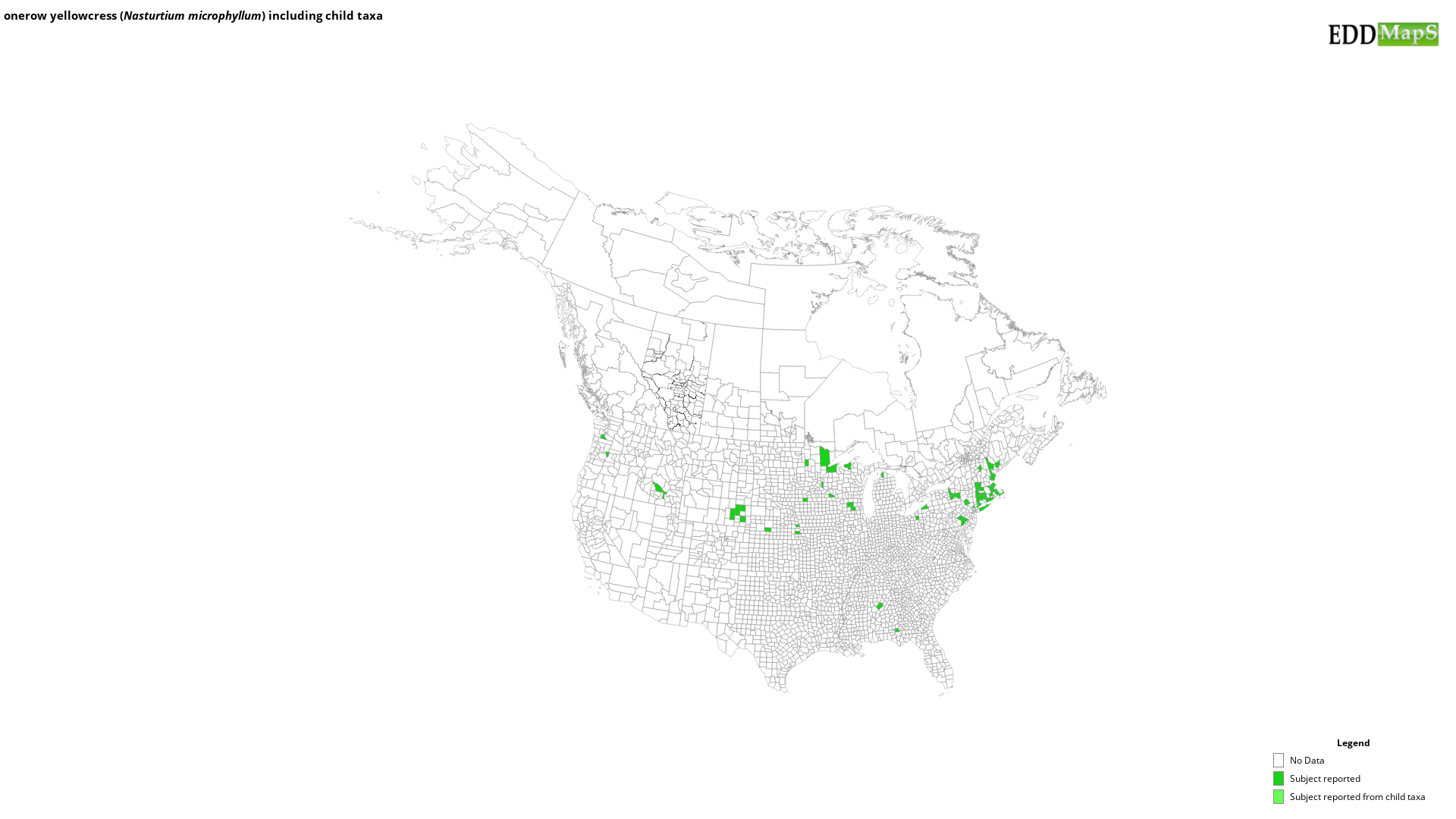
EDDMapS Distribution - This map is incomplete and is based only on current site and county level reports made by experts, herbaria, and literature. For more information, visit www.eddmaps.org
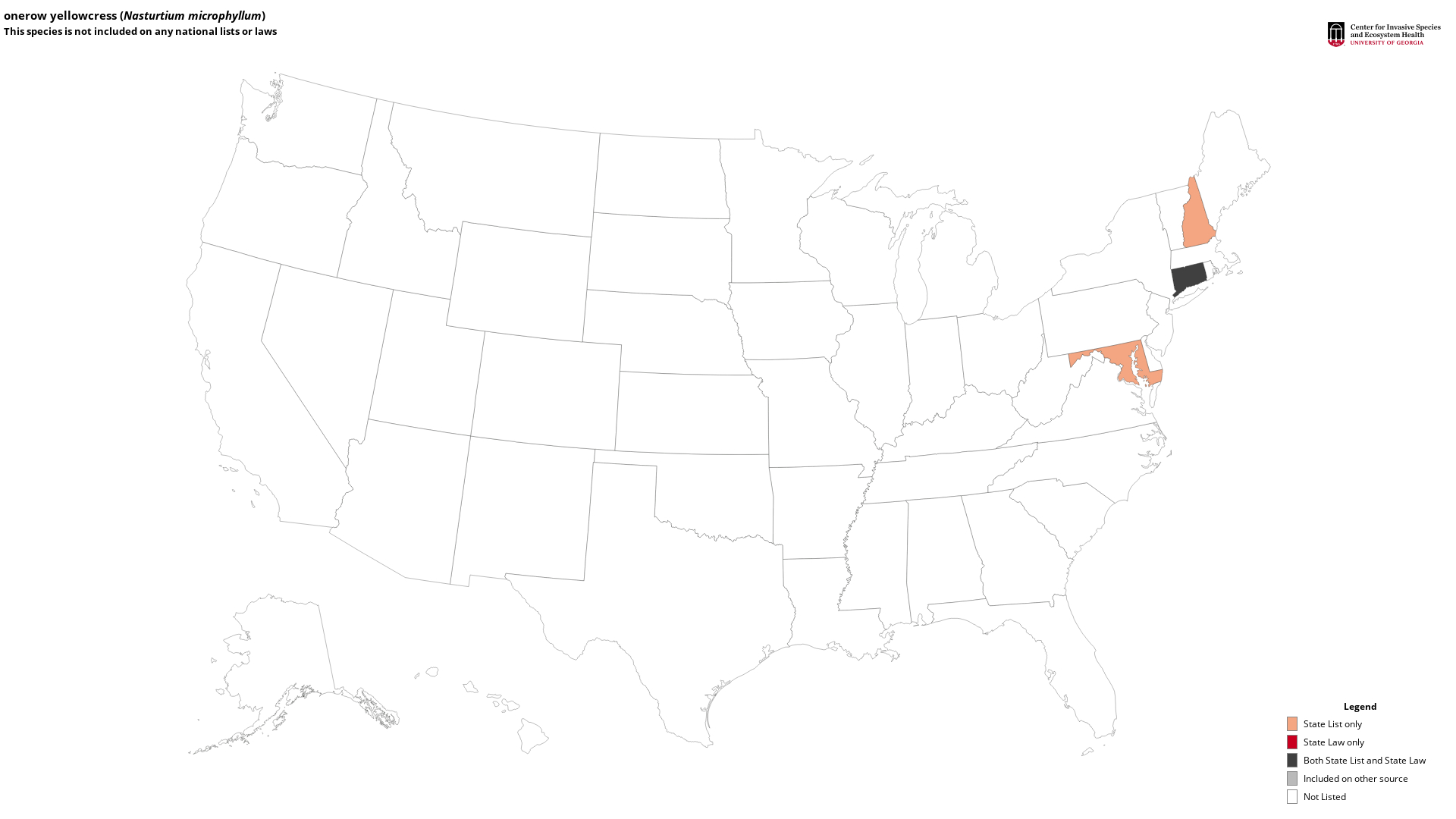
State Lists - This map identifies those states that have this species on their invasive species list or law.
Invasive Listing Sources
- Connecticut Invasive Plant List
- Connecticut Invasive Plant Working Group
- Jil M. Swearingen, Survey of invasive plants occurring on National Park Service lands, 2000-2007
- Maryland Aquatic Nuisance Species Plan
- New Hampshire Invasive Plant Species Watch List
- New Hampshire Invasive Species Committee. 2005. Guide to Invasive Upland Plant Species in New Hampshire. New Hampshire Department of Agriculture, Markets and Food Plant Industry Division and New Hampshire Invasive Species Committee.
- New Invaders of the Northeast and Northcentral
- To be proposed for MISC
- WeedUS - Database of Plants Invading Natural Areas in the United States
Taxonomic Rank
| Domain: Eukarya |
| Kingdom: Plantae |
| Phylum: Magnoliophyta |
| Class: Magnoliopsida |
| Superorder: Rosanae |
| Order: Brassicales |
| Family: Brassicaceae |
| Genus: Nasturtium |
| Nasturtium microphyllum |
References
Common Name Reference: USDA, NRCS. 2010. The PLANTS Database. National Plant Data Center, Baton Rouge, LA, USA.
Scientific Name Reference: USDA, NRCS. 2010. The PLANTS Database. National Plant Data Center, Baton Rouge, LA, USA.