
European privet
(Ligustrum vulgare)
This species is Introduced in the United States
Appearance
Ligustrum vulgare is a semi-evergreen shrub or small tree that grows to 20 ft. (6.1 m) in height. Trunks usually occur as multiple stems with many long, leafy branches.
Foliage
Leaves are opposite, lanceolate, 1-2.4 in. (2.5-6 cm) long and 0.2-0.6 in. (0.5-1.5 cm) wide.
Flowers
Flowering occurs from April to June when panicles of white to cream flowers develop in the terminal and upper axillary clusters. Pollen can cause an allergic reaction in some people.
Fruit
The abundant fruits are spherical, 0.3-0.05 in. (1-1.3 cm) long. Fruit begins green and ripens to a dark purple to black in color and persists into winter. Birds and wildlife eat the fruit and disperse the seeds. Seed soil viability is about one year. It also colonizes by root sprouts.
Ecological Threat
Ligustrums can tolerate a wide range of conditions. They form dense thickets invading fields, fencerows, roadsides, forest understories, and riparian sites. They can shade out and exclude native understory species, perhaps even reduce tree recruitment. Native to Europe and Asia, they are commonly used as ornamental shrubs and for hedgerows.
Citations
Winston, R.L., Andreas, J.E., Milan, J., DesCamp, W., Randell, C.B., and M. Schwarzländer. 2014. New Invaders of the Northwest. United States Department of Agriculture, Forest Health Technology Enterprise Team. FHTET-2014-12. Retrieved from https://www.fs.fed.us/foresthealth/technology/pdfs/FHTET-2014-12_NW_New_Invaders.pdf
Resources
- A Field Guide for the Identification of Invasive Plants in Southern Forests - USDA Forest Service
- Southeast Exotic Pest Plant Council Invasive Plant Manual - SE-EPPC
- Element Stewardship Abstract - The Nature Conservancy
- Fire Effects Information System - USDA Forest Service
- Weed of the Week - USDA Forest Service
- Plant Invaders of Mid-Atlantic Natural Areas - National Park Service and U.S. Fish and Wildlife Service
Selected Images
Maps
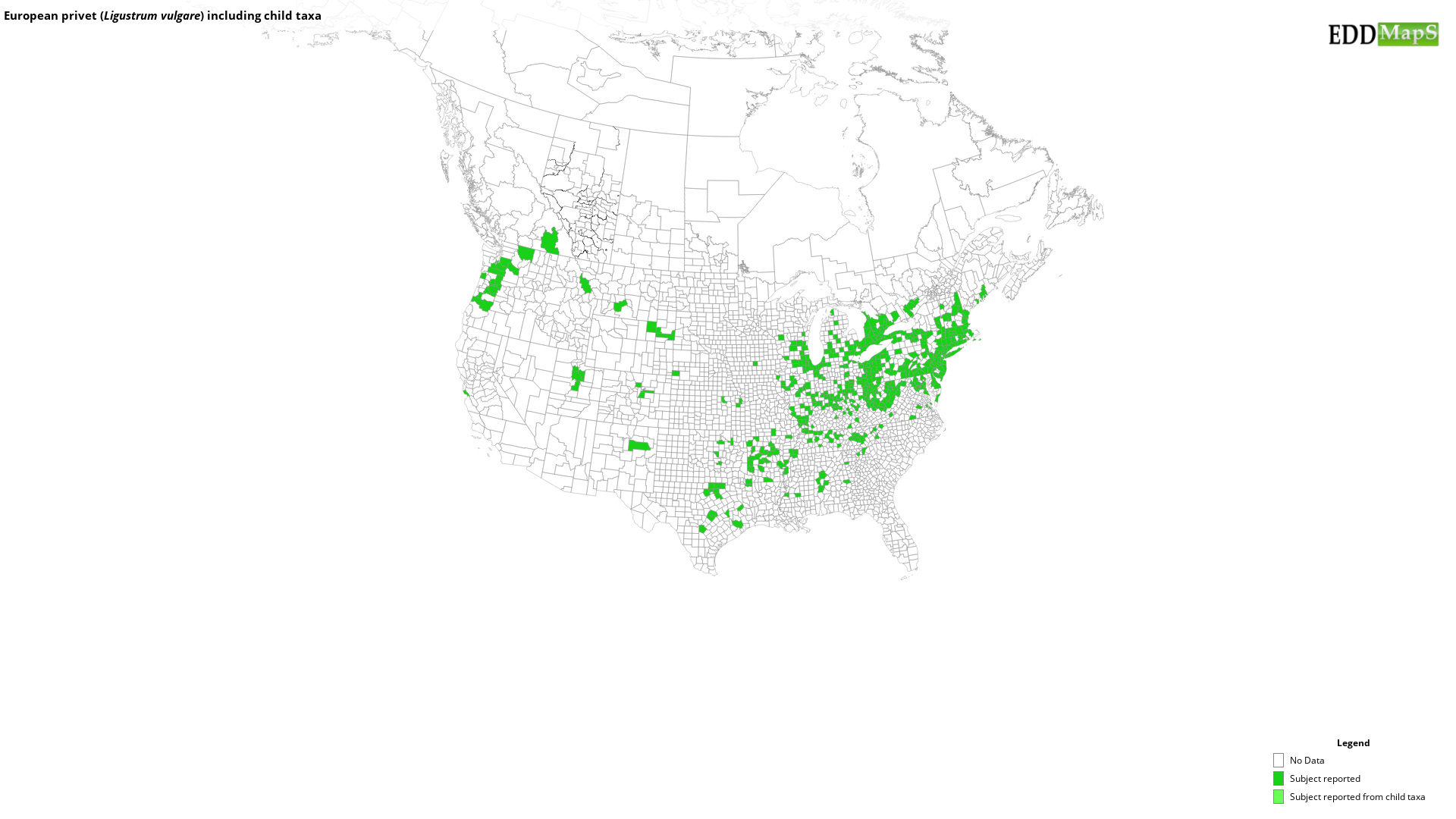
EDDMapS Distribution - This map is incomplete and is based only on current site and county level reports made by experts, herbaria, and literature. For more information, visit www.eddmaps.org

State Lists - This map identifies those states that have this species on their invasive species list or law.
Invasive Listing Sources
- City of Ann Arbor Michigan Parks and Recreation
- Commonwealth of Pennsylvania, Department of Conservation and Natural Resources, 1994.
- Connecticut Invasive Plant List
- Connecticut Invasive Plant Working Group
- Delaware Invasive Species Council
- Hoffman, R. & K. Kearns, Eds. 1997. Wisconsin manual of control recommendations for ecologically invasive plants. Wisconsin Dept. Natural Resources, Bureau of Endangered Resources. Madison, Wisconsin. 102pp.
- Indiana Invasive Species Council - Invasive Plant List
- Invasive Plant Species of West Virginia
- Jil M. Swearingen, Survey of invasive plants occurring on National Park Service lands, 2000-2007
- John Randall, The Nature Conservancy, Survey of TNC Preserves, 1995.
- Maine Invasive Plants
- Maryland Department of Agriculture's Candidates for Listing of Invasive Plants
- Maryland Department of Natural Resources Policy: Restriction on Planting Exotic Invasive Plants
- National Park Service, Mid-Atlantic Exotic Plant Management Team Invasive Plant List
- Native Plant Society of Oregon, 2008
- New Hampshire Invasive Species Committee. 2005. Guide to Invasive Upland Plant Species in New Hampshire. New Hampshire Department of Agriculture, Markets and Food Plant Industry Division and New Hampshire Invasive Species Committee.
- New Hampshire Prohibited Invasive Species
- New Invaders of the Northwest
- New Jersey Invasive Species Management Act
- New Jersey Invasive Species Strike Team 2017 Invasive Species List
- Non-Native Invasive Plants of Arlington County, Virginia
- Non-Native Invasive Plants of the City of Alexandria, Virginia
- Nonnative Invasive Species in Southern Forest and Grassland Ecosystems
- Ohio Invasive Species Council
- Ontario’s Invading Species Awareness Program Tracked Species List
- Pennsylvania Department of Conservation and Natural Resources Invasive Plants
- Pennsylvania Noxious Weeds
- Pennsylvania's Field Guide to Aquatic Invasive Species
- Plant Invaders of Mid-Atlantic Natural Areas
- Reichard, Sarah. 1994. Assessing the potential of invasiveness in woody plants introduced in North America. University of Washington Ph.D. dissertation.
- Rhode Island Natural History Survey
- South Carolina Invasive Pest Council
- Tennessee Noxious Weeds
- WeedUS - Database of Plants Invading Natural Areas in the United States
- West Virginia Invasive Species Strategic Plan and Volunteer Guidelines 2014
- West Virginia Native Plant Society, Flora West Virginia Project, and West Virginia Curatorial Database System, September 3, 1999
Taxonomic Rank
| Domain: Eukarya |
| Kingdom: Plantae |
| Phylum: Magnoliophyta |
| Class: Magnoliopsida |
| Superorder: Asteranae |
| Order: Lamiales |
| Family: Oleaceae |
| Genus: Ligustrum |
| Ligustrum vulgare |
References
Common Name Reference: USDA, NRCS. 2010. The PLANTS Database. National Plant Data Center, Baton Rouge, LA, USA.
Scientific Name Reference: USDA, NRCS. 2010. The PLANTS Database. National Plant Data Center, Baton Rouge, LA, USA.