
hairy willowherb
(Epilobium hirsutum)
This species is Introduced in the United States
Appearance
Epilobium hirsutum is a semi-aquatic perennial herbaceous plant. The plant is erect, branching, covered with soft hairs, and grows up to 6 ft. (1.8 m) tall. E. hirsutum is native to Africa, temperate Asia, and Europe.
Foliage
E. hirsutum leaves are opposite, sessile, and clasp the stem. Leaf-blades are lanceolate-elliptic to narrowly obovate or elliptic 1.6-4.7 in. (4-12 cm) long and 0.12-1.6 in. (0.3-4 cm) wide. Foliage is villous both above and below with a serrulate margin. The leaf tip is acute to acuminate.
Flowers
Solitary flowers are held on stems arising from the upper leaf axils. Stems can be floating or lying on the ground. The flowers are showy with bright pink to dark purple notched petals with white centers.
Fruit
E. hirsutum reproduces by seeds, rhizomes, and stolons. Fruits are narrow, pubescent, dehiscent seed pods from 1-3.5 in. (2.5-9 cm) long that contain numerous seeds. Seeds have long white hairs that aid in dispersal by wind.
Ecological Threat
E. hirsutum is an extremely widespread and variable species that spreads aggressively by vegetative growth in sunny open wetland habitats, although it can also invade uplands. It can form monocultures in natural wetlands, crowding out native species.
Citations
Winston, R.L., Andreas, J.E., Milan, J., DesCamp, W., Randell, C.B., and M. Schwarzländer. 2014. New Invaders of the Northwest. United States Department of Agriculture, Forest Health Technology Enterprise Team. FHTET-2014-12. Retrieved from https://www.fs.fed.us/foresthealth/technology/pdfs/FHTET-2014-12_NW_New_Invaders.pdf
Selected Images
Maps
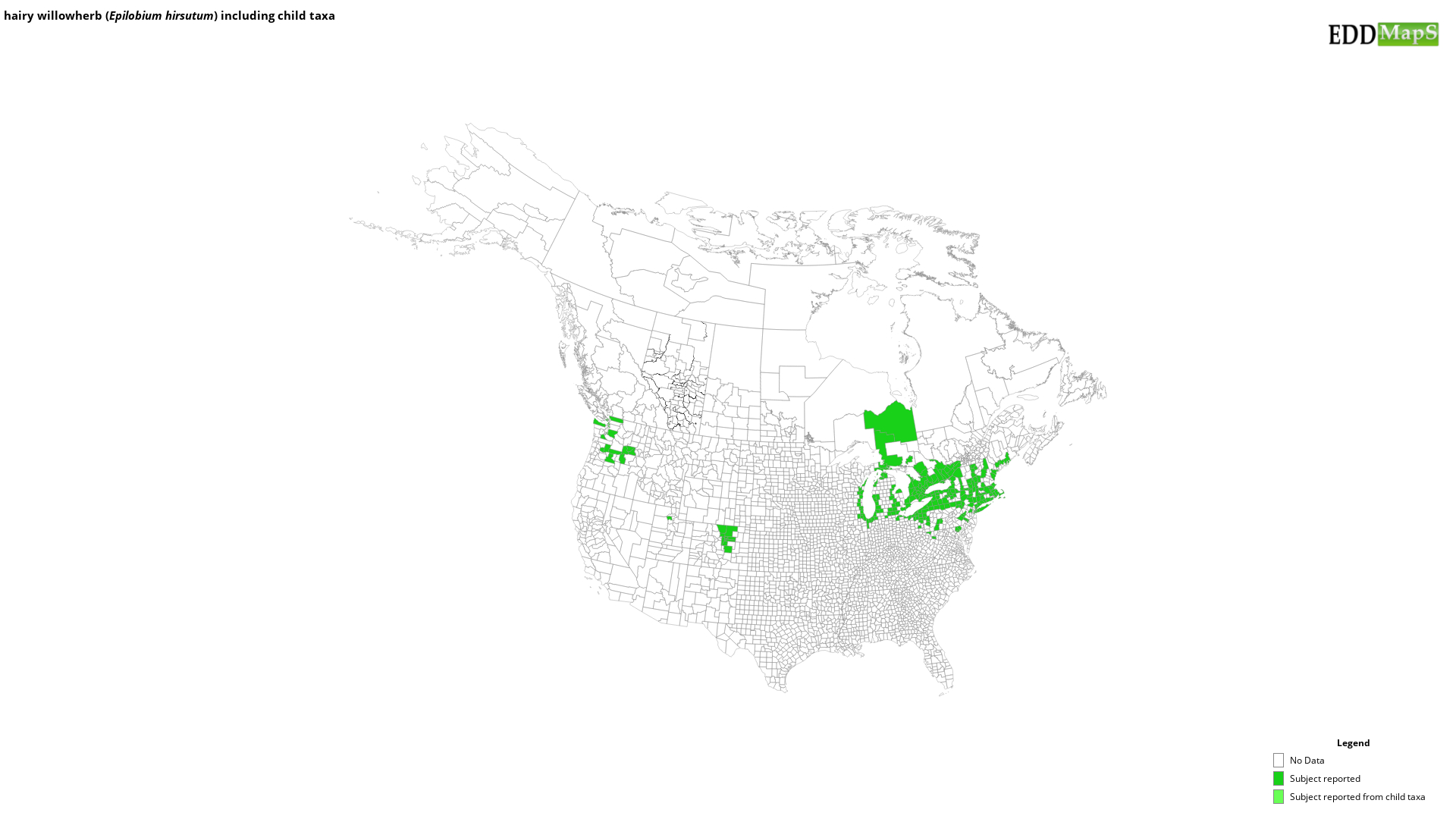
EDDMapS Distribution - This map is incomplete and is based only on current site and county level reports made by experts, herbaria, and literature. For more information, visit www.eddmaps.org
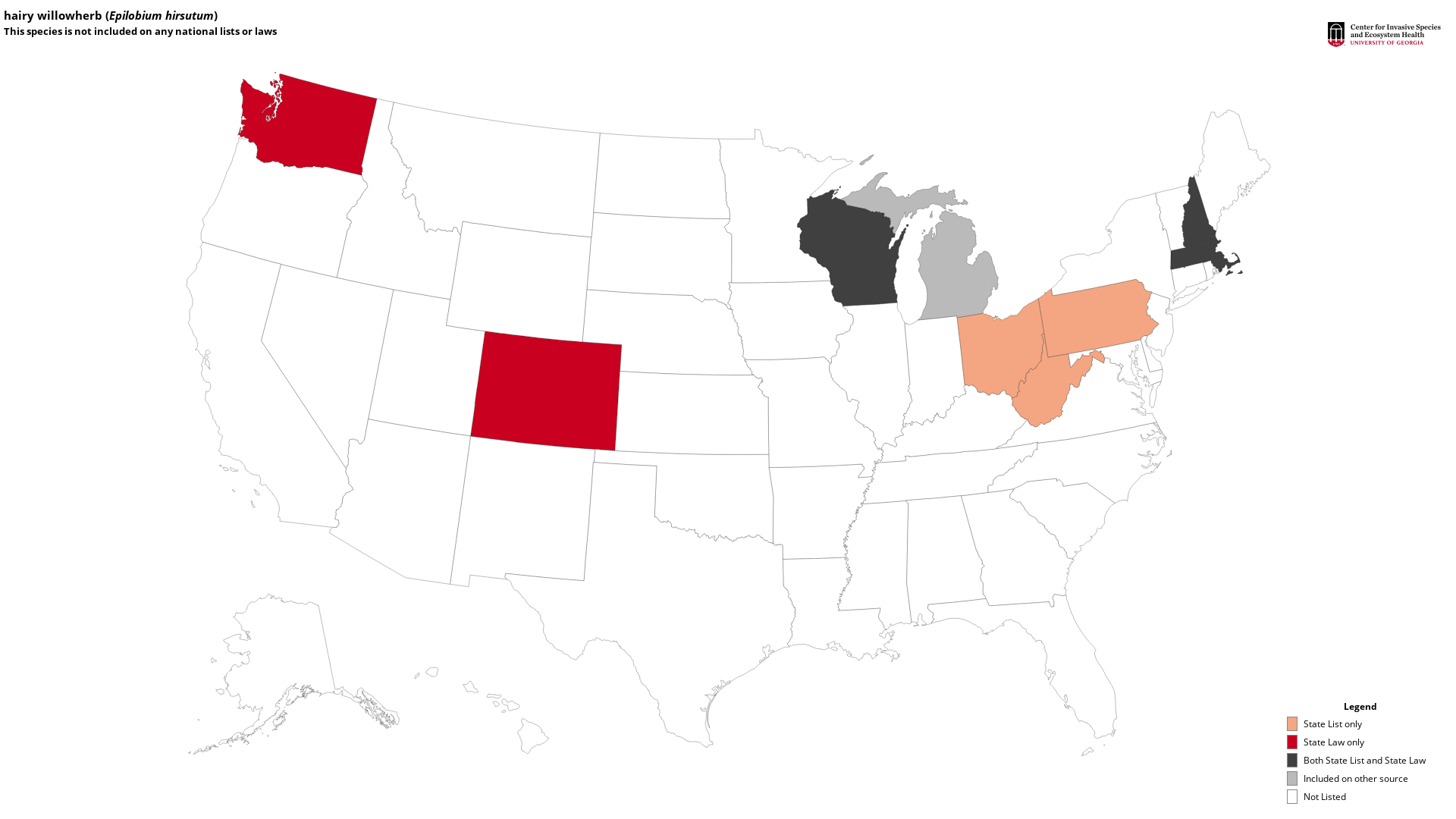
State Lists - This map identifies those states that have this species on their invasive species list or law.
Invasive Listing Sources
- City of Ann Arbor Michigan Parks and Recreation
- Colorado Noxious Weeds
- Hoffman, R. & K. Kearns, Eds. 1997. Wisconsin manual of control recommendations for ecologically invasive plants. Wisconsin Dept. Natural Resources, Bureau of Endangered Resources. Madison, Wisconsin. 102pp.
- Invasive Plant Species of West Virginia
- Massachusetts Invasive Plants Advisory Group List
- Massachusetts Noxious Weeds
- Massachusetts Prohibited Plant List
- National Park Service, Mid-Atlantic Exotic Plant Management Team Invasive Plant List
- New Hampshire Invasive Plant Species Watch List
- New Hampshire Invasive Species Committee. 2005. Guide to Invasive Upland Plant Species in New Hampshire. New Hampshire Department of Agriculture, Markets and Food Plant Industry Division and New Hampshire Invasive Species Committee.
- New Hampshire Prohibited Aquatic Species
- New Invaders of the Northwest
- Ohio Invasive Species Council
- Ontario’s Invading Species Awareness Program Tracked Species List
- Pacific Northwest Exotic Pest Plant Council, 1998
- Pennsylvania Department of Conservation and Natural Resources Invasive Plants
- Washington Noxious Weeds
- WeedUS - Database of Plants Invading Natural Areas in the United States
- West Virginia Native Plant Society, Flora West Virginia Project, and West Virginia Curatorial Database System, September 3, 1999
- Wisconsin's Invasive species rule – NR 40
Taxonomic Rank
| Domain: Eukarya |
| Kingdom: Plantae |
| Phylum: Magnoliophyta |
| Class: Magnoliopsida |
| Superorder: Rosanae |
| Order: Myrtales |
| Family: Onagraceae |
| Genus: Epilobium |
| Epilobium hirsutum |
References
Common Name Reference: Weed Science Society of America Common Names List
Scientific Name Reference: USDA, NRCS. 2010. The PLANTS Database. National Plant Data Center, Baton Rouge, LA, USA.