
glossy privet
(Ligustrum lucidum)
This species is Introduced in the United States
Appearance
Ligustrum lucidum is a semi-evergreen shrub or small tree that grows up to 40 ft. (12.2 m) in height. The trunks usually occur as multiple stems with many long, leafy branches.
Foliage
Leaves are opposite, ovate to lanceolate, 3-6 in. (5-15.2 cm) long and 2-4 in. (5-10.2 cm) wide.
Flowers
Flowering occurs in late spring to late summer, when very abundant, white flowers develop at the end of branches in 5-8 in. (12.7-20 cm) long clusters.
Fruit
Fruits are <0.5 in. (1.3 cm) long, oval, fleshy, and ripen to a dark blue to black color. Fruits persist into winter.
Ecological Threat
Several privet species occur and they are often very hard to distinguish. Ligustrum lucidum resembles Japanese privet (L. japonicum Thunb.), but the leaves of Japanese privet are shorter (2 in. [5.1 cm] long) and thicker. Ligustrum lucidum commonly forms dense thickets in fields or in the understory of forests. It shades and out-competes many native species, and once established, is very difficult to remove. It is commonly used as an ornamental shrub and for hedgerows.
Citations
Rawlins, K.A., R.L. Winston, C.T. Bargeron, D.J. Moorhead, and R. Carroll. 2018. New Invaders of the Northeast and Northcentral United States. USDA Forest Service, Forest Health Assessment and Applied Sciences Team, Morgantown, West Virginia. FHTET-2017-04. Retrieved from https://bugwoodcloud.org/resource/pdf/FHTET-2017-04_New%20Invaders_NE.pdf
Resources
- Invasive Species Management Plans for Florida - University of Florida - Center for Aquatic and Invasive Plants
- A Field Guide for the Identification of Invasive Plants in Southern Forests - USDA Forest Service
- Element Stewardship Abstract - The Nature Conservancy
Selected Images
Maps
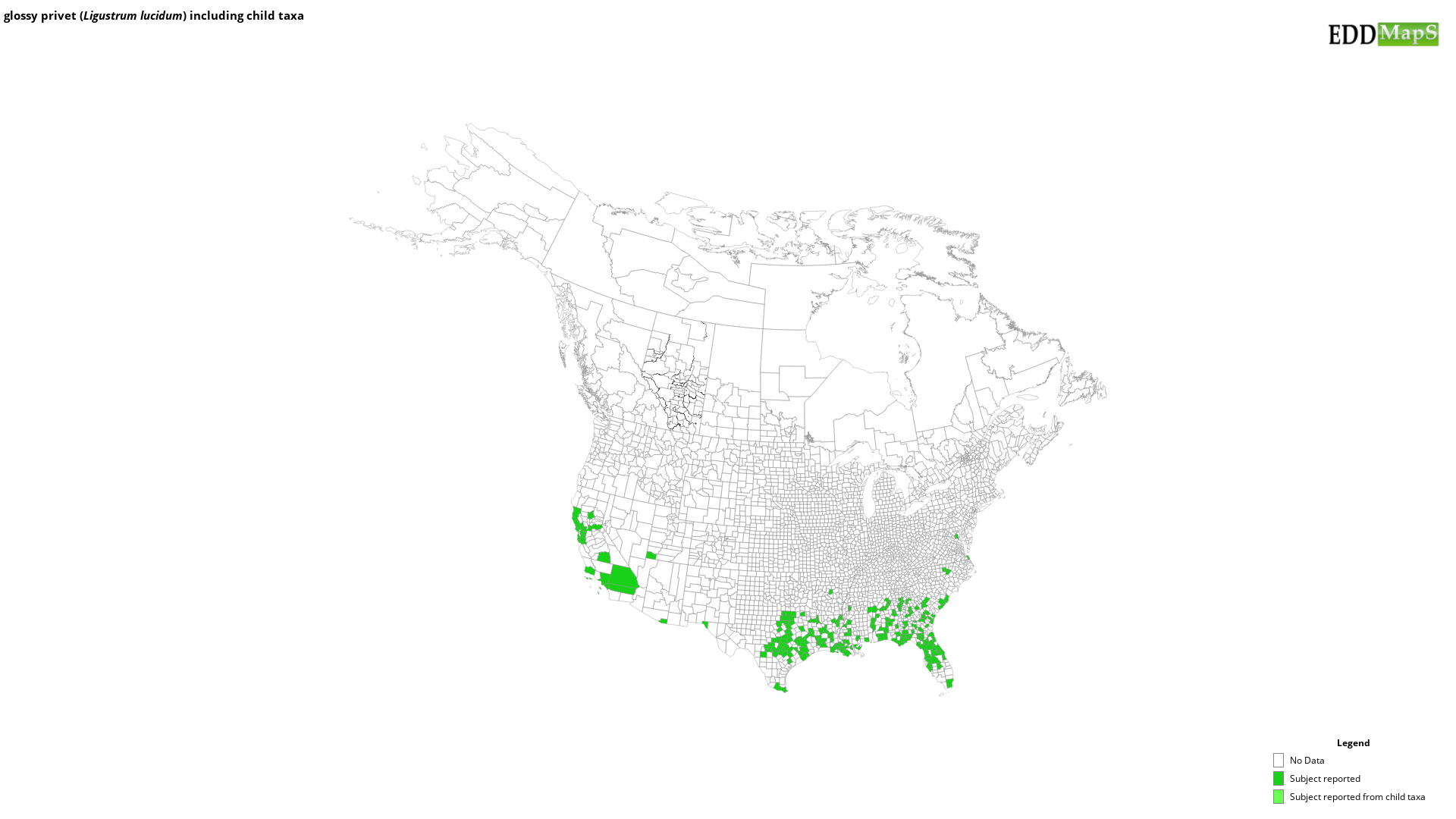
EDDMapS Distribution - This map is incomplete and is based only on current site and county level reports made by experts, herbaria, and literature. For more information, visit www.eddmaps.org
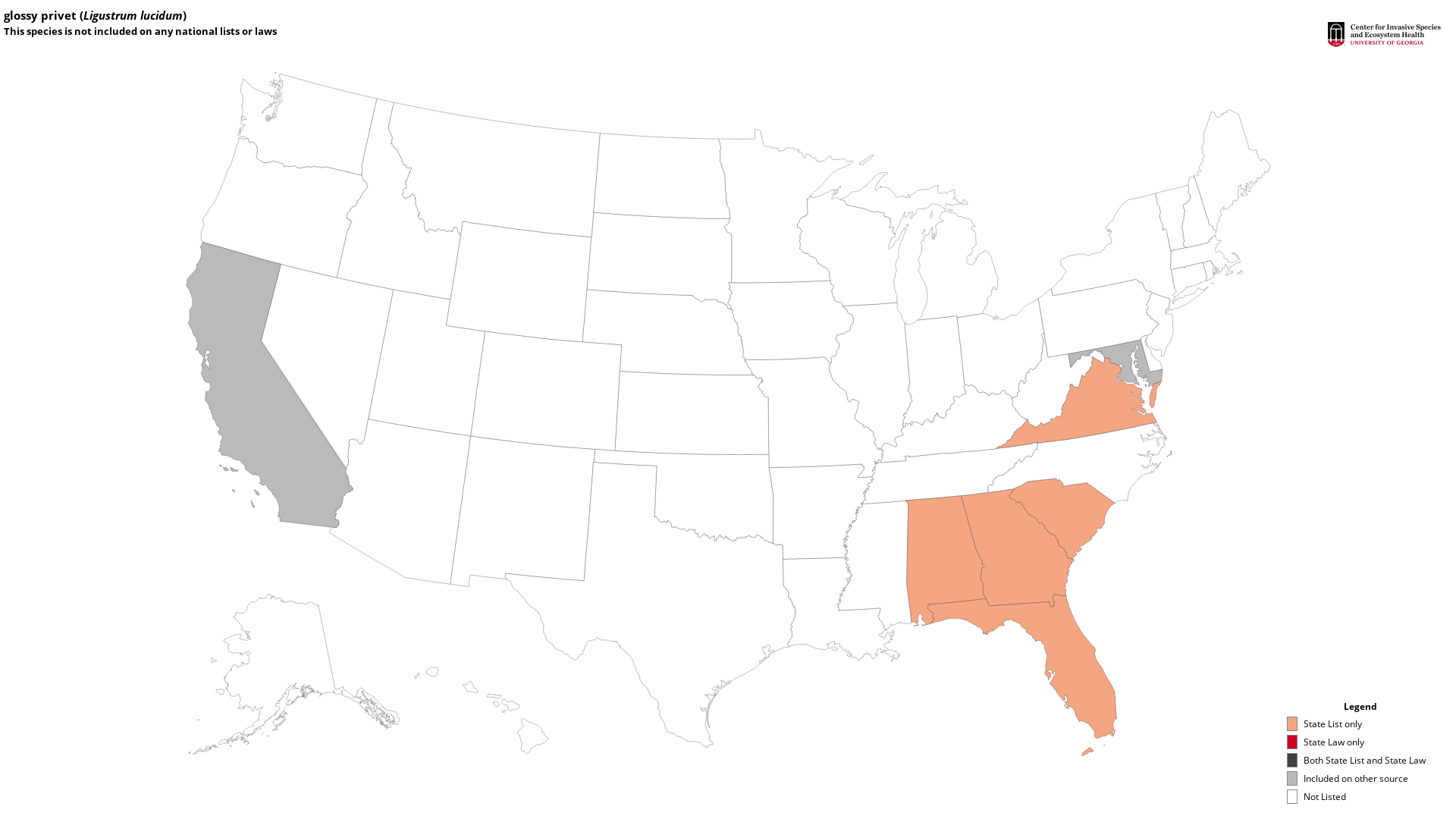
State Lists - This map identifies those states that have this species on their invasive species list or law.
Invasive Listing Sources
- Alabama Invasive Plant Council
- Alachua County Cogongrass Initiative
- Apalachicola Invasive Working Group
- California Invasive Plant Council
- Florida Invasive Species Council List of Invasive Plant Species - Category I
- Georgia Exotic Pest Plant Council - Category 3
- Jil M. Swearingen, Survey of invasive plants occurring on National Park Service lands, 2000-2007
- Maryland Invasive Species Council - Invasive Species of Concern in Maryland
- National Park Service, Mid-Atlantic Exotic Plant Management Team Invasive Plant List
- New Invaders of the Northeast and Northcentral
- Non-Native Invasive Plants of Arlington County, Virginia
- Nonnative Invasive Species in Southern Forest and Grassland Ecosystems
- Reichard, Sarah. 1994. Assessing the potential of invasiveness in woody plants introduced in North America. University of Washington Ph.D. dissertation.
- South Carolina Invasive Pest Council
- Treasure Coast Cooperative Invasive Species Mgmt. Area
- WeedUS - Database of Plants Invading Natural Areas in the United States
Taxonomic Rank
| Domain: Eukarya |
| Kingdom: Plantae |
| Phylum: Magnoliophyta |
| Class: Magnoliopsida |
| Superorder: Asteranae |
| Order: Lamiales |
| Family: Oleaceae |
| Genus: Ligustrum |
| Ligustrum lucidum |
References
Common Name Reference: USDA, NRCS. 2010. The PLANTS Database. National Plant Data Center, Baton Rouge, LA, USA.
Scientific Name Reference: USDA, NRCS. 2010. The PLANTS Database. National Plant Data Center, Baton Rouge, LA, USA.