
Argentine black and white tegu
(Salvator merianae)
This species is Introduced in the United States
Origin
Salvator merianae or Argentine black and white tegu is native to South America. Argentine black and white tegu, brought in through the pet trade, have been intentionally released or escaped enclosures.
Life Cycle
Adult Argentine black and white tegus have a mottled black and white coloration that often is arranged into a banding pattern across the back and tail. Young S. merianae possess a distinct bright green coloration on their head that fades after they reach about one month of age. These reptiles can grow 4 ft (1.3 yd) long, weigh up to 10 lbs (4.5 kg) or more and live 20 years. As omnivorous lizards, tegu can eat fruits, eggs, insects, small animals, and pet food that is left outside. Argentine black and white tegu are terrestrial reptiles that are active during the day. Tegus live in open savannas and disturbed landscapes. Adult S. merianae have few predators. Female S. merianae lay approximately 35 eggs a year after reaching reproductive maturity at about 12 in. (30 cm) in length. In winter, tegus enter a hibernation-like state, known as brumation, in burrows or under vegetation.
Distribution
Known breeding populations of Argentine black and white tegu are found in the Florida counties of Charlotte, Hillsborough, Miami-Dade and St. Lucie.
Control Efforts
S. merianae threaten native wildlife species. Species such as American alligator (Alligator mississippiensis), American crocodiles (Crocodylus acutus), gopher tortoise (Gopherus polyphemus), sea turtles, ground-nesting birds, and small mammals are all at risk.
In Florida, tegus (genera Salvator and Tupinambis, all species) are classified as Prohibited nonnative species. Prohibited species may only be possessed by permit for educational exhibition, research, or eradication/control activities.
In Georgia, the Georgia Department of Natural Resources is working with the U.S. Geological Survey and Georgia Southern University to address tegus in Toombs and Tattnall. With support from USGS and DNR, Georgia Southern is trapping tegus and following up on local sightings. DNR is also investigating occasional reports of tegus elsewhere in Georgia. Georgia DNR has classified S. merianae as a Wild Animal, and now requires a permit to possess this species in captivity. It is now illegal to breed or sell tegus in Georgia. All individuals in captivity before December 2023 are grandfathered in, and do not require a permit but they must have been chipped and reported to GA DNR before December 2023.
https://georgiawildlife.com/tegus
Argentine Black and White Tegu Species Profile
Resources
- Argentine Black and White Tegu Species Profile - Florida Fish and Wildlife Conservation Commission
Selected Images
Maps
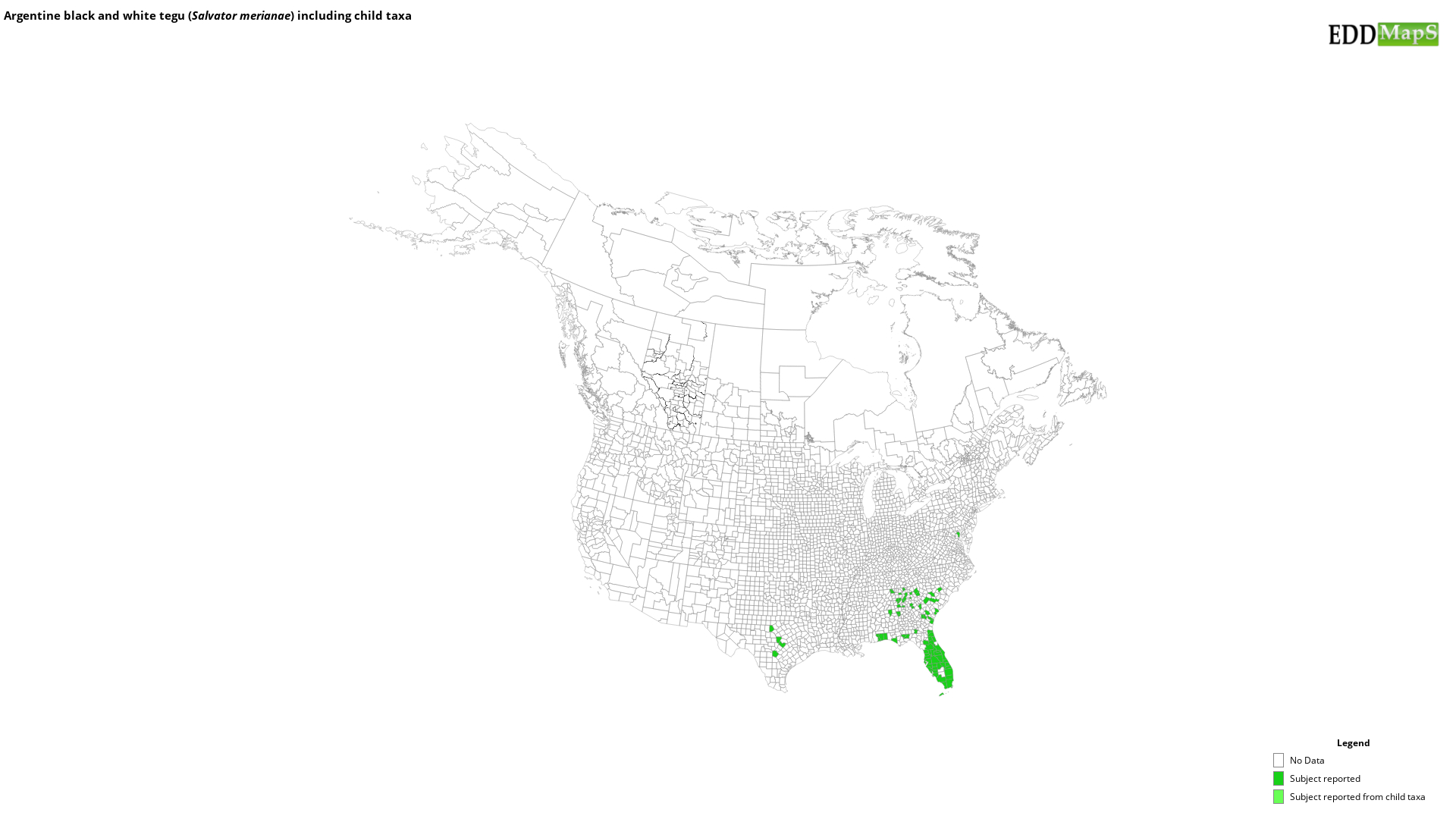
EDDMapS Distribution - This map is incomplete and is based only on current site and county level reports made by experts, herbaria, and literature. For more information, visit www.eddmaps.org
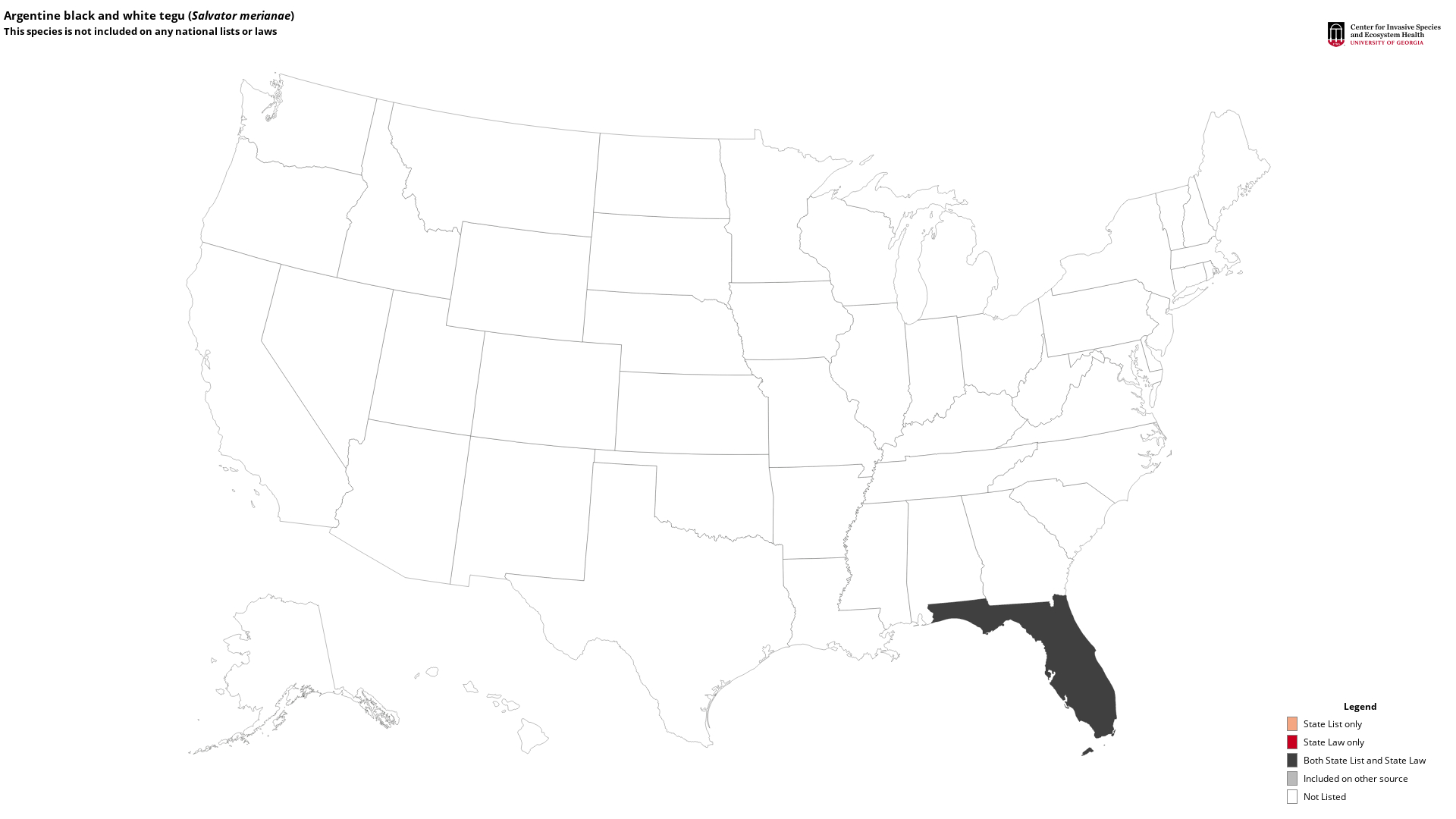
State Lists - This map identifies those states that have this species on their invasive species list or law.
Invasive Listing Sources
Taxonomic Rank
| Domain: Eukarya |
| Kingdom: Animalia |
| Phylum: Chordata |
| Class: Reptilia |
| Order: Squamata |
| Suborder: Sauria |
| Family: Teiidae |
| Genus: Salvator |
| Salvator merianae |
References
Common Name Reference: Roskov Y., Abucay L., Orrell T., Nicolson D., Kunze T., Culham A., Bailly N., Kirk P., Bourgoin T., DeWalt R.E., Decock W., De Wever A., eds. (2015). Species 2000 & ITIS Catalogue of Life, 2015 Annual Checklist. Digital resource at www.catalogueoflife.org/annual-checklist/2015. Species 2000: Naturalis, Leiden, the Netherlands. ISSN 2405-884X.
Scientific Name Reference: Roskov Y., Abucay L., Orrell T., Nicolson D., Kunze T., Culham A., Bailly N., Kirk P., Bourgoin T., DeWalt R.E., Decock W., De Wever A., eds. (2015). Species 2000 & ITIS Catalogue of Life, 2015 Annual Checklist. Digital resource at www.catalogueoflife.org/annual-checklist/2015. Species 2000: Naturalis, Leiden, the Netherlands. ISSN 2405-884X.