
capybara
(Hydrochoerus hydrochaeris)
This species is Introduced in the United States
Origin
Hydrochoerus hydrochaeris is native throughout South America. Capybara were introduced to the United States as escaped pets.
Life Cycle
As the largest rodent, H. hydrochaeris can weight up to 150 lbs (68 kg) and stand 2 ft (0.6 m) in height and 4 ft (1.2 m) in length. H. hydrochaeris are large semi-aquatic herbivores found in freshwater marshes, swamps, rivers, and lakes. Capybara reaches sexual maturity around 1.5 years of age or when they reach weights of 66-88 lbs (30-40 kg). Females generally have 1 litter of 5 pups per year with individuals living in herds.
Distribution
H. hydrochaeris are established in Florida.
Control Efforts
More research is needed on the potential impacts of capybara and its threat to human health, environmental harm, and economic harm.
https://edis.ifas.ufl.edu/uw438
https://nas.er.usgs.gov/queries/FactSheet.aspx?SpeciesID=2587
Hydrochoerus hydrochaeris is native throughout South America. Capybara were introduced to the United States as escaped pets.
Life Cycle
As the largest rodent, H. hydrochaeris can weight up to 150 lbs (68 kg) and stand 2 ft (0.6 m) in height and 4 ft (1.2 m) in length. H. hydrochaeris are large semi-aquatic herbivores found in freshwater marshes, swamps, rivers, and lakes. Capybara reaches sexual maturity around 1.5 years of age or when they reach weights of 66-88 lbs (30-40 kg). Females generally have 1 litter of 5 pups per year with individuals living in herds.
Distribution
H. hydrochaeris are established in Florida.
Control Efforts
More research is needed on the potential impacts of capybara and its threat to human health, environmental harm, and economic harm.
https://edis.ifas.ufl.edu/uw438
https://nas.er.usgs.gov/queries/FactSheet.aspx?SpeciesID=2587
Selected Images
Maps

EDDMapS Distribution - This map is incomplete and is based only on current site and county level reports made by experts, herbaria, and literature. For more information, visit www.eddmaps.org
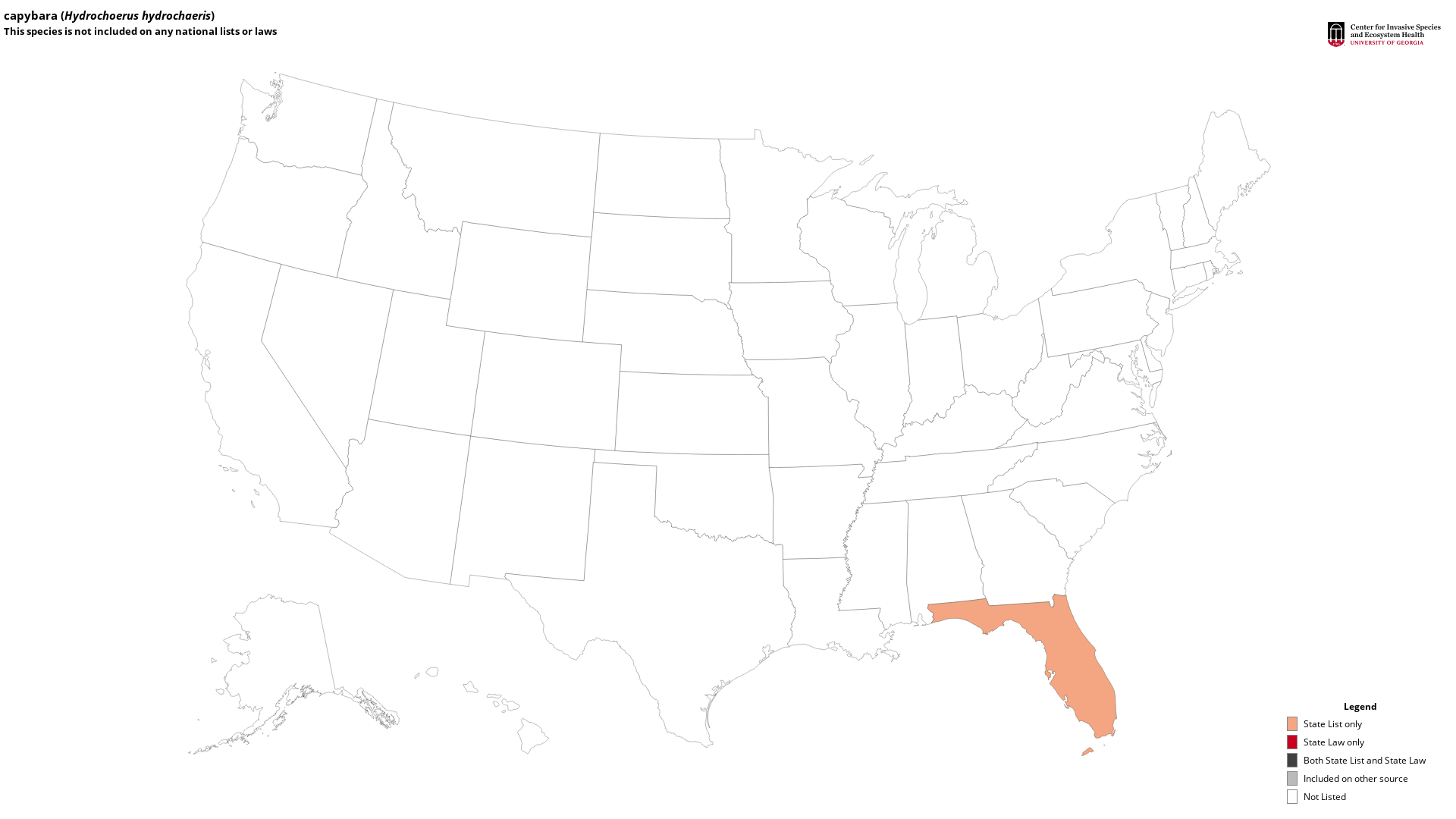
State Lists - This map identifies those states that have this species on their invasive species list or law.
Invasive Listing Sources
Taxonomic Rank
| Domain: Eukarya |
| Kingdom: Animalia |
| Phylum: Chordata |
| Class: Mammalia |
| Subclass: Theria |
| Order: Rodentia |
| Suborder: Hystricognatha |
| Infraorder: Hystricognathi |
| Family: Caviidae |
| Subfamily: Hydrochoerinae |
| Genus: Hydrochoerus |
| Hydrochoerus hydrochaeris |
References
Common Name Reference: Web Search - http://animaldiversity.ummz.umich.edu/site/accounts/classification/Hydrochoerus_hydrochaeris.html
Scientific Name Reference: Web Search - http://animaldiversity.ummz.umich.edu/site/accounts/classification/Hydrochoerus_hydrochaeris.html